
Community Revitalization Through the Eyes of an Urbanist
By Carolyn Badaracco
Beauty is in the eye of the beholder when it comes to neighborhood reinvestment projects across the country. Georgia is experiencing that subjectivity when it comes to what some call “gentrification.”
On one hand, redevelopment can refresh urban and suburban landscapes while generating profit for investors. On the other, it can bring rising property taxes that long-time residents struggle to absorb.
Georgia Insider sat down with Eric Kronberg, principal, owner and founder of Kronberg Urbanists Architects in the Cabbagetown neighborhood of Atlanta, to examine the impact of community revitalization from an urbanist’s perspective.
Free movement
Kronberg’s design studio takes a multidisciplinary approach to urban design, considering zoning codes, underutilized buildings, imbalances in residential and commercial development, public policy, and real estate strategy.
The firm’s mission is to help design and activate flourishing neighborhoods across Georgia and beyond, with a focus on long-term economic productivity.
“We think flourishing neighborhoods have inclusive, attainable housing and nearby commercial goods and services that allow you to thrive with less dependency on cars,” Kronberg said.
While driving will remain part of daily life, a more sustainable approach to redevelopment gives residents options.
“We want people to have choices to get around their own community without being forced to own a car for every trip they need to make,” he said.
Equitable solutions on the table
What does equitable redevelopment look like?
“That’s often the holy grail people are chasing,” Kronberg said.
“If we say we need to invest in a community to provide goods and services, better housing options, and more inclusivity, that can affect property values,” he added.
To minimize displacement, meaning long-time residents being forced to move due to rising costs, Kronberg’s team looks for ways to balance investment with stability.
So what drives displacement?
“It is an increase in property taxes, which either raises the burden on homeowners, often on fixed incomes, or increases rents as landlords pass along those costs,” he said.
Kronberg believes policy solutions are essential.
“If we want to be thoughtful about investment and minimize displacement, we need to look at appropriate property tax relief policies, likely at the state level,” he said.
One approach is age-targeted tax relief, where programs reduce property taxes for residents in their mid-60s and older. Kronberg is not convinced.
“I’m not a fan of age-targeted property tax relief, personally, because Boomers are sitting on the wealth,” he said. “Income-targeting is more appropriate.”
Georgia policymakers are exploring ways to address the issue, including reducing property taxes for developments that use long-term housing tax credits to provide affordable housing.
According to HousingWire’s “The Builder’s Daily,” affordable housing advocates in Georgia are advancing a constitutional amendment aimed at limiting property tax increases on Low Income Housing Tax Credit (LIHTC) properties.
The proposal would treat these properties as a separate class for ad valorem tax purposes. The report also notes that housing affordability is expected to be a central issue on November’s midterm ballots.
Accessible dwelling units
Kronberg points to another potential solution gaining traction nationally: accessible dwelling units, or ADUs.
Some cities allow homeowners to build a secondary unit on their property.
“So you could build in the back to generate rental income or house a family member,” he said.
However, financing remains a major barrier. Homeowners often need significant upfront capital to build an ADU.
“If you’re in a disinvested neighborhood, your odds of having access to capital to build a $150,000 unit in your backyard is slim to none,” Kronberg said. “Banks prefer to lend on separate properties with assets they can foreclose on.”
While ADUs are not widely permitted in Georgia, policy changes could shift that. If secondary units were legally recognized as separate properties, financing would become more feasible.
“There are still access-to-capital challenges, but the financial side becomes much simpler,” Kronberg said. “And your property taxes could decrease because your primary asset is valued differently.”
Other states are already moving in this direction.
“It is happening in Seattle because Washington passed a state-level housing policy requiring cities to allow this,” Kronberg said. “Massachusetts is considering something similar.”
In Atlanta, Mayor Andre Dickens co-chaired the National Emergency Housing Task Force, which has explored similar ideas.
“This task force has strong recommendations from around the country,” Kronberg said, including allowing ADUs to be sold individually, permitting multiple units per lot, reducing minimum lot sizes, eliminating parking requirements, and encouraging housing near transit.
“We have none of these in our current proposed zoning rewrite,” he added. “I’ve been working on helping the planning department move forward.”
An apt analogy
Kronberg says one overlooked factor in city economics is the financial productivity of land.
“You can think about land like farmland,” he said. “More fertile land grows better crops. Monoculture strips the soil of its resources.”
He argues that large-lot, single-family zoning functions similarly.
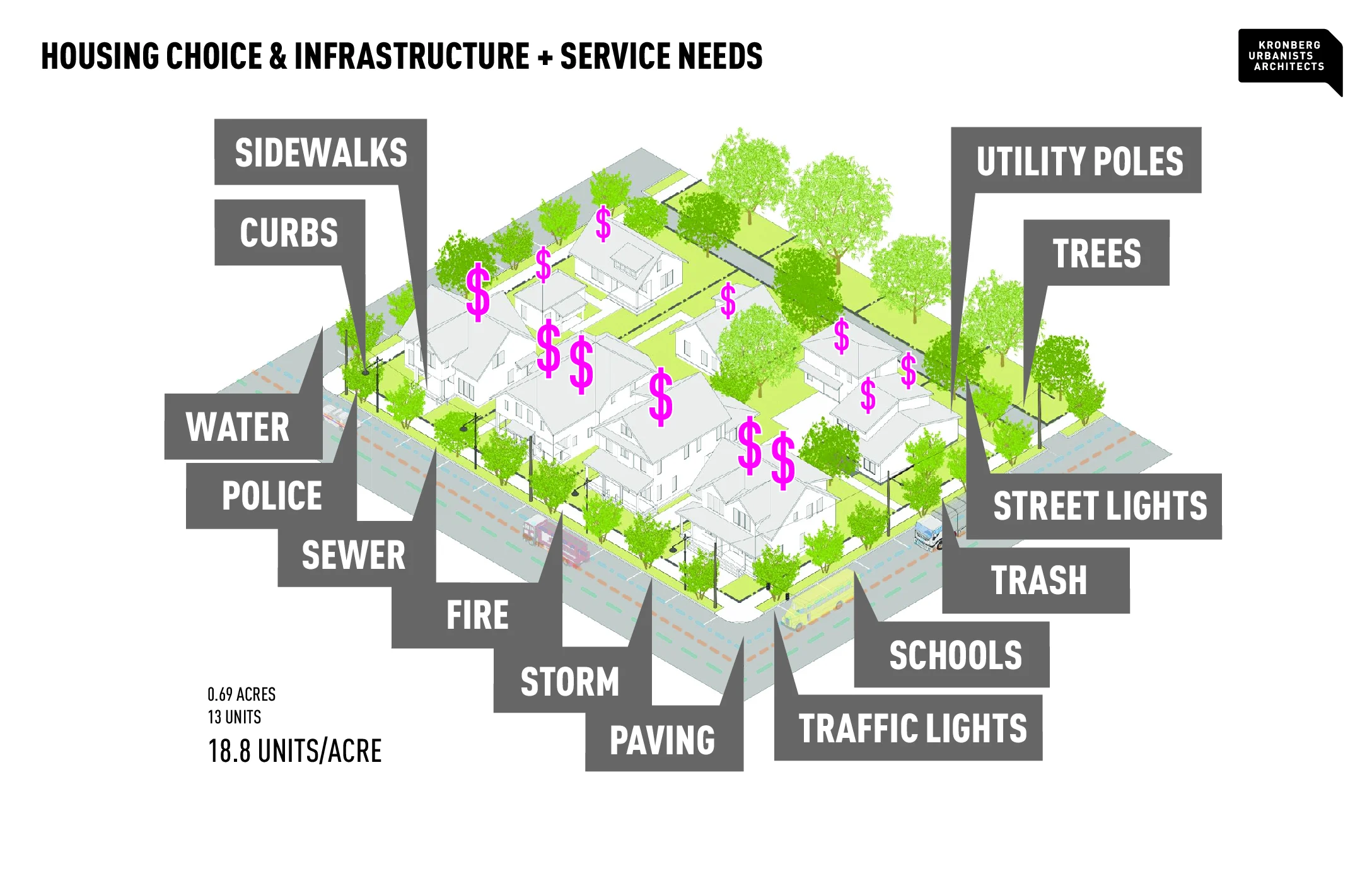
“When you require large-lot single-family housing across most of a city, that is a monocrop that produces low tax yields,” he said. “It makes it harder to pay for infrastructure like water systems and other core services.”
In contrast, smaller, denser, mixed-use development can generate stronger economic returns while supporting community needs.
“In the 1940s and 1950s, America and Atlanta had about four people per household,” Kronberg said. “By 2023, Atlanta was down to about two. That means you need twice as many houses to support the same population.”
That shift has real economic consequences.
“If you want your corner store, wine bar, or grocery store to thrive, it takes a critical mass of people living nearby,” he said. “But people also need to be able to afford to stay in those communities.”

Carolyn Badaracco is a senior writer and editor whose work has appeared in Atlanta Business Chronicle, American City & County, Midwest Real Estate News, The Atlanta Journal-Constitution, National Real Estate Investor (Wealth Management Real Estate), and the American Institute of Architects’ publications. She is a graduate of the University of Missouri School of Journalism who has called Atlanta home for 30 years.
Stay connected with Georgia Insider
Sign up for the Briefing and follow us on LinkedIn or Instagram.
Reach the state’s most influential
Are you a thought leader with a perspective on Georgia’s economy, policy or innovation landscape? Contact us to learn about speaking and panel opportunities or how to contribute insights, opinion and commentary.
Sponsor
The Briefing
The Georgia Insider briefing delivers clear, concise insight to help leaders anticipate challenges, identify opportunities and navigate the state’s political and economic landscape with confidence.
Sponsor

